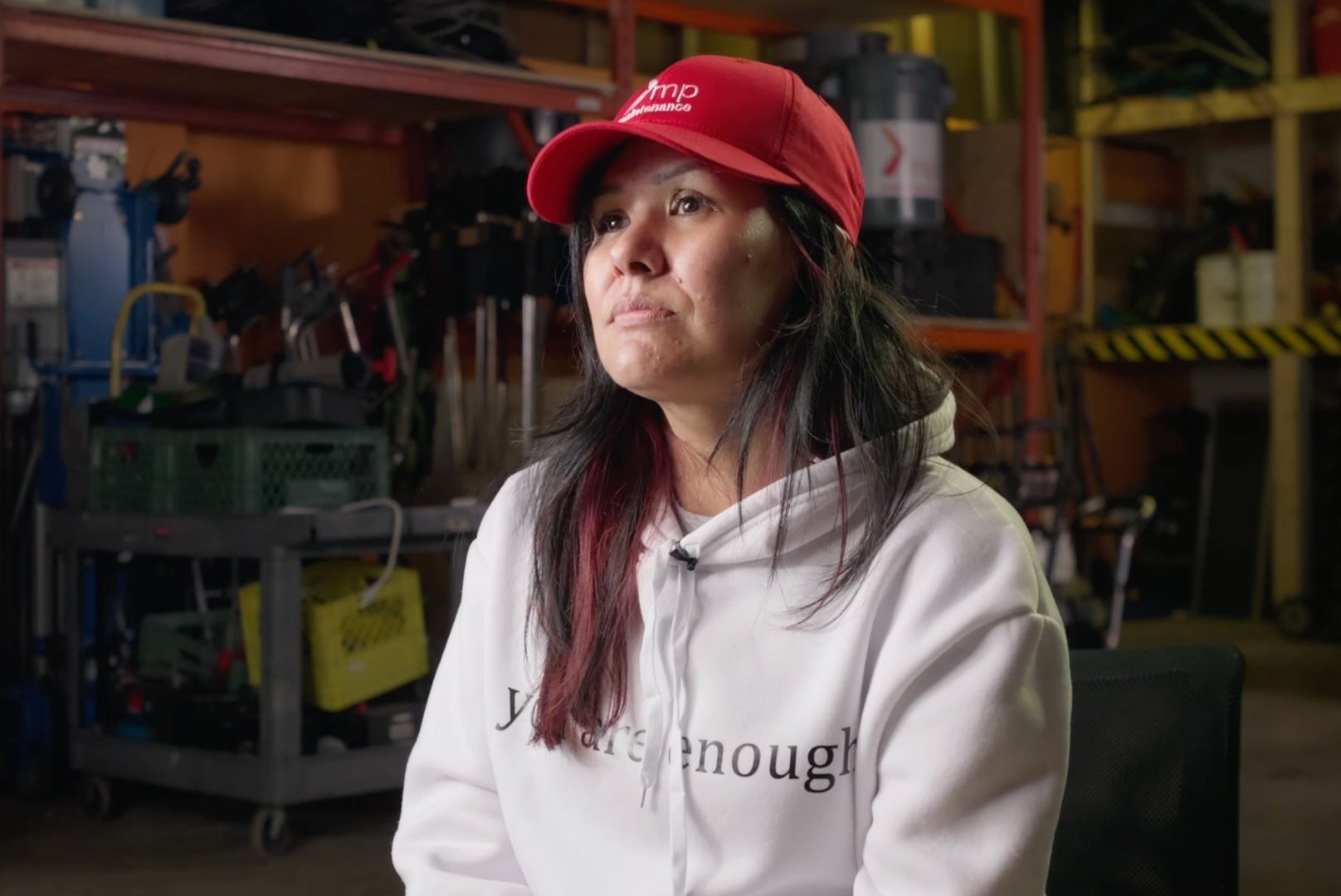
Rochelle was born in the northern Manitoba community of Tadoule Lake. The area is very remote, accessible only by propeller plane most of the year, but has beautiful winter and summer landscapes. She was raised on the Sayisi Dene First Nation community with around 300 other members, but felt disconnected from her Indigenous culture. While she was taught how to cut caribou meat, tan caribou hide, and fillet lake fish, she feels like there was more to learn. "To be honest, I don't really know my culture… I never gave my granny a chance to teach me that, and I really wish I did," she shares.
In a community as small as Tadoule Lake, Rochelle had very little to do besides play outside with her brothers. There was also limited access to good education, with single classrooms often spanning multiple grades. "There were very few opportunities," she shares. "All you can do out there is like drink and get high, and that's normal." By 14 years old, Rochelle started smoking weed and by 17 she had her first drink.
"In my early twenties, I drank a lot and I used drugs. I was a very angry person, a very angry person," Rochelle shares. "I was lost and broken and I didn't know why."
Looking for a new start, Rochelle, her children, and their father moved to Winnipeg. She was hoping to begin her recovery journey away from the reserve and find better education for her children, but unfortunately her substance use only worsened. "I had to lose everything. I had to hit my rock bottom before I knew I was ready to change, before I knew that I had to get sober or else I was gonna die.”
“I had to hit my rock bottom. I had to lose my place, I had to lose my kids, my job, everything."
Eventually, Rochelle's parents intervened and encouraged her to start a recovery program near them so they could support her. She completed the first step of the program and moved into transitional housing in Vancouver's Downtown Eastside. Determined to stay on her recovery journey, Rochelle began working on the next steps to a stable life, including getting a job. "I was really nervous to be honest, because I hadn't worked in so many years," she shares. A caseworker knew of other residents who had shared similar concerns at one point in their journey, and had succeeded in Mission Possible's Employment Readiness Program.
So, Rochelle enrolled.
Rochelle often worked on the Women's Team, a safe space for women and non-binary people to feel empowered in a male-dominated industry. There, she connected deeply with her supervisor, who supported her and helped her build friendships with others. "She was really good and I think what made me connect with her more was the fact that we both had a lot in common… I was able to confide in her," she shares.
Occasionally, working in the DTES was challenging for Rochelle, who is still early in her recovery journey. When she was feeling triggered or overwhelmed, she found that her coaching sessions helped her refocus on her path forward. "Having somebody motivate you and talk to you and let you know you're doing good, that really, really made me feel really good about myself," she shares, "I worked hard for where I am at right now."
After completing her 6-month contract on the Clean Team, Rochelle knew that the Peer Support Program was the next step for her, sharing, "If I [hadn't gone] into the peer support training, I don't think I would've been able to figure out what I wanted to do." It was difficult to balance school, job training, and a work placement, but having a strong support system at MP helped. "Without them, I don't think I would've gone through with [the peer support program]," she shares.
Today, Rochelle feels more confident, more empathetic, and has learned to connect with others more. The skills that she learned during her time at MP have helped her succeed outside of the program, where she is now employed permanently as a Support Worker at the very same organization where she started her recovery journey. "The job readiness program actually gave me a stepping stone…They helped me with finding a job," she shares.
Looking forward, Rochelle knows the journey doesn't end here. "Sometimes I don't believe like, how far I've made it," she shares, "I'm learning how to love myself again, and how to be a mother, a daughter, and a sister... I've become a better version of myself."
Check out more ways Mission Possible is making an impact on lives just like Rochelle's in our 2025/2026 Annual Report!
.png?width=400&height=100&name=Untitled%20design%20(1).png "Untitled design (1)")


-2.jpg)